-
(818) 833-8737
13521 Hubbard St.Sylmar, CA 91342
- Login
VOTE - Ballot Measures - Unbiased Explanations
Posted on 10/23/2026
The League of Women Voters of California is a nonpartisan, grassroots organization working to protect and expand voting rights, build grassroots power in our communities, drive policy change on the biggest challenges facing our state, and ensure everyone is represented in our democracy.
Below are the League of Women Voters of California’s recommendations** on the propositions appearing on the November 3, 2026 ballot. We base our recommendations on League positions developed through study and member consensus, and the LWVC Board of Directors carefully reviews each measure before taking a position.
**The LWVC Education Fund has provided an unbiased explanation of each ballot measure to help voters make informed decisions. Visit the link at the end of each recommendation for more about each measure.
Follow Link to View Ballot Measures
https://lwvc.org/ballot-recommendations/
Read Their Recommendations Online - (https://lwvc.org/ballot-recommendations/#online)
Download Vote With The League (PDF) - https://lwvc.org/vote-with-league/
- Vote with the League: Ballot Recommendations (PDF version of our online ballot recommendations)
- Vote with the League: Quick Reference Guide (Two-page summary of our ballot recommendations)
- Vote with the League: A Deep Dive on Ballot Recommendations (Detailed analysis & explanation of recommendations)
- NEW! Vote with the League: Answer Key Flyer (One-page flyer with quick list of recommendations)
Funding from the 2018 bond for broad affordable housing programs has been spent, and there is a corresponding backlog of affordable housing projects stuck waiting for years for financing. Many families in California continue to endure high housing costs, leading to an increase in homelessness and overcrowding. Public subsidy is necessary to provide safe and stable housing for households at the lowest incomes.
Prop 1 authorizes $10 billion in general obligation bonds for the construction, acquisition, rehabilitation, and preservation of affordable housing and for homeownership programs, plus $1.25 billion, also in general obligation bonds, for veteran mortgage assistance through the CalVet Home Loan Program, expected to be repaid from borrowers’ mortgage payments. https://cavotes.org/ballot-measure/2026-prop-1/
Proposition 2
SAVE FOR CALIFORNIA’S FUTURE ACT
Proposition 2 will allow California to save more money during strong economic years so it can protect schools and other essential services when revenues fall.
California’s budget can change dramatically from one year to the next. The state relies heavily on personal income taxes, including taxes on capital gains. Capital gains are profits people earn when they sell stocks, businesses, real estate, or other investments. These taxes bring in much more money when financial markets are doing well, but that revenue can disappear quickly during an economic downturn.
Prop 2 would help California prepare for those swings. It would allow the state to build a larger rainy-day fund and require it to save more when capital gains revenues are unusually high. That would give California a stronger financial cushion during recessions, natural disasters, public health emergencies, and other difficult periods.
Saving more during good years can help prevent deep cuts to public services during bad years. It can also reduce the need for emergency borrowing and other painful budget actions. https://cavotes.org/ballot-measure/2026-prop-2/
Proposition 3
CHILDREN’S EDUCATION & HEALTH CARE PROTECTION
Proposition 3 would protect funding for schools, health care, and other essential services by keeping California’s current income tax rates on the highest-income 2 percent of taxpayers. Without Prop 3, those rates would fall in 2031, reducing state revenue by an estimated $5 billion to $15 billion each year. Prop 3 would not change anyone’s tax rate today.
About 40 percent of this revenue goes to schools and community colleges. The rest helps fund Medi-Cal and other health and human services, other essential public services, and state budget reserves.
California should not give its highest-income residents a multi-billion-dollar tax cut while schools, health care, and other essential services face serious financial pressure. Prop 3 simply asks the top 2 percent to keep paying the same rates they already pay. The League strongly supports the measure because it protects vital services, helps California weather economic downturns, and keeps the state’s tax system fair. https://cavotes.org/ballot-measure/2026-prop-3/
Proposition 4
CALIFORNIA FAIR ELECTIONS ACT
Elections should be won, not bought. But in California, personal wealth and access to big donors have become unofficial qualifications for public office. Qualified candidates without wealthy networks are often shut out before voters hear their ideas, while candidates and officeholders spend too much time chasing large checks.
Prop 4 gives Californians a way to change that. It lifts California’s near-total ban on public campaign financing and allows the state and local governments to create voluntary programs. The measure creates no financing program and provides no campaign funding by itself. Each jurisdiction decides whether to adopt a program and how to design and pay for it.
Public financing can make small donations matter more, give candidates without personal fortunes a fairer chance to compete, and let them spend more time listening to voters. By reducing the advantage of incumbents, wealthy donors, and special interests, these programs can make elections more open, competitive, and accountable.
They can also open the door to candidates who better reflect California. Latino, Asian American or Pacific Islander, and Black Californians make up nearly two-thirds of our population but remain vastly underrepresented in local government across much of the state. High campaign costs help keep that barrier in place. When voters can choose candidates who understand their communities and reflect their interests, they have more reason to participate.
Prop 4 protects public money. Candidates must show broad grassroots support and agree to spending limits. Money reserved for education, transportation, or public safety cannot be used. Programs cannot favor incumbents or discriminate by party. Public funds cannot pay legal defense costs or fines or repay a candidate’s personal loan to a campaign. Finally, the measure triples the maximum fine for illegal foreign money in California elections.
Prop 4 gives every California community the freedom to build elections where voters have more power and wealthy donors and special interests have less. https://cavotes.org/ballot-measure/2026-prop-4/
Proposition 5
RECALL ELECTION REFORM FOR STATEWIDE OFFICERS
California’s recall gives voters a way to remove a corrupt or failed official. It should never become a back door to state office for a replacement candidate propped up by only a small fraction of voters. However, that is exactly what today’s recall rules allow, since the same ballot that decides removal also determines a replacement based on whoever gets the most votes, even if that’s far short of a majority.
Prop 5 fixes a built-in contradiction in the recall process. Voters are asked to remove an officer by majority vote, then hand that same office to a replacement chosen by whomever gets the most votes, often in a field crowded with dozens of candidates and with no requirement that the winner reach half the vote. That’s a loophole that can easily be exploited. In 2021, had the recall against Governor Newsom succeeded, the leading replacement candidate would have taken office with the support of just 28% of recall voters, a stark illustration of exactly this problem.
Prop 5 restores the recall to its proper purpose: deciding whether an official should remain in office. It shuts down that back door with one clean fix: removing the replacement candidate vote from the recall ballot itself. If a recall succeeds, the vacancy is filled through succession, appointment, or a later election decided by real majority support. These are the same rules used to fill any other vacancy in state government. A recalled officer can still run again later. This is a pro-democracy safeguard too – the choice stays with voters rather than being taken away entirely. What Prop 5 rules out is any return to office through appointment, so a recalled officer can only reclaim the seat by winning a real vote.
This is a matter of basic fairness and majority rule. Prop 5 protects accountability while ending a system that can hand power to a candidate most voters never chose. https://cavotes.org/ballot-measure/2026-prop-5/
Proposition 37
LOAN PROGRAM FOR MIDDLE-INCOME BUYERS OF NEW HOMES
California must build more homes and make homeownership possible for more families. The League of Women Voters of California has worked toward those goals for decades and supports Prop 1, which would provide $10 billion for affordable housing and homeownership programs and $1.25 billion for veterans’ home loans.
Prop 37 addresses a real barrier: the down payment. But it does so by adding a second mortgage that buyers generally would repay every month.
- Prop 37 could help a family buy a home without making it affordable to keep. Buyers generally would repay the Prop 37 loan each month in addition to their first mortgage, property taxes, insurance, repairs, and other costs. Voters would not know the interest rate, loan term, or monthly payment before approving the program.
- The program could reinforce racial and economic gaps instead of targeting families facing the greatest barriers. Generations of housing discrimination have left many Black and Latino families with less wealth to draw on, but Prop 37 gives no priority to first-time or first-generation buyers and does not exclude current or former homeowners. Households earning up to twice the area median income could qualify, including some earning more than $300,000 a year, while buyers would still have to provide at least 3 percent of the home price.
- The program is not tied to good planning. Assistance could be used only for newly built or newly converted homes, with no requirement that they be near jobs, transit, schools, or services or avoid areas with high transportation, insurance, or natural-hazard costs.
- Too much remains undecided. The Legislative Analyst says it is uncertain whether investors would buy the bonds, how the loans would compare in cost with other assistance, or whether the program would result in more homes being built or purchased. The interest rate and repayment terms would be set after the election.
California needs homeownership programs that lower families’ total costs, confront racial barriers to building wealth, and support strong communities. Prop 37 does not meet that test. https://cavotes.org/ballot-measure/2026-prop-37/
Proposition 38
BONDS FOR IMMUNOLOGY MEDICAL RESEARCH
Medical research can save lives, but Prop 38 is the wrong way to fund it. It would authorize $8.4 billion in borrowing for immunology and immunotherapy research and require the state to make $500 million to $600 million in annual debt payments for about 20 years. Those payments would come from the General Fund, which also pays for schools, health care, and other public services.
- Borrowing is a poor way to pay for ongoing scientific research. Bonds are best suited to long-lived investments such as buildings and infrastructure. With interest, the Legislative Analyst estimates Prop 38 would cost about 10 percent more, after adjusting for inflation, than paying for the research up front.
- Prop 38 would lock billions of dollars into one field of research for years to come. About half of the money would go to a single UC-affiliated research institute and the other half to a grant program, with at least $4.2 billion reserved for cancer, heart disease, and Alzheimer’s research. Scientific opportunities and public health needs change. State funding should be able to respond to those changes rather than locking billions of dollars into one field of research through a ballot measure.
- Research royalties are no reason to take on $8.4 billion in debt. When voters approved $3 billion for stem-cell research in 2004, supporters pointed to royalties and millions in new state revenue. By 2022, CIRM reported only $15.6 million in its licensing and royalties fund from royalty payments. Prop 38 again points to research-generated revenue as a way to offset public costs, but the Legislative Analyst says the amount and timing are unknown.
California can support important medical research without committing taxpayers to decades of debt and restricting future choices about where limited public dollars can do the most good. https://cavotes.org/ballot-measure/2026-prop-38/
Proposition 39
PROHIBITS VOTING WITHOUT GOVERNMENT-ISSUED ID
Prop 39 is a partisan power grab to further President Trump’s voter suppression efforts. It is based on lies about our elections. Prop 39 is intended to make it harder to vote and easier for politicians to decide which voters count. Right-wing billionaires spent millions to put it on the ballot.
- California’s elections are already secure. Voters swear to citizenship under penalty of perjury, and officials verify identity at registration, check the rolls in person, and match every mail ballot signature.
- A new registration hurdle. Millions of existing voters could be forced to effectively re-register to “designate” a government ID for mail voting, like a driver’s license or Social Security number.
- Identity theft risk. You would be required to put the last four digits of that sensitive ID number on the outside of your ballot envelope – next to your name, address, and signature.
- Valid ballots thrown out. Your mailed ballot would not be counted if the number you wrote didn’t match the “designated” number. One wrong digit or a blank field could sink a valid ballot, with no guaranteed notice or chance to fix it. Texas tried this and rejected one in eight mail ballots. Those voters were less likely to vote again.
- An ID check every time you vote in person. You would have to show a government-issued ID every time, even after officials verified who you are. Most voters turned away under similar laws elsewhere had qualifying ID, just not on them.
- A modern-day poll tax. A “free” ID is not free. Getting one costs transportation, childcare, time off work, and fees for the paperwork behind it. Seniors, students, low-income workers, voters with disabilities, and voters of color are hit hardest.
- Valid ID still must match. Nearly 30 percent of U.S. adults have changed their name, 94 percent of them women. Californians who took a new name at marriage, and transgender voters whose documents lag may hold valid ID and be turned away anyway.
- Bad data and wrongful purges. Citizenship checks would likely run through untrustworthy federal databases that wrongly flag eligible citizens to purge them from voter rolls.
- Longer lines and slower results. Extra ID checks and flagged ballots add delay, and the lawsuits would stretch it further, handing election deniers more time to spread lies.
- Hundreds of millions of dollars every year. New systems, staffing, free ID cards, audits, and lawsuits, all paid for while California already has budget problems. https://cavotes.org/ballot-measure/2026-prop-39/
Proposition 40
BILLIONAIRE TAX
Prop 40 would tax extreme wealth to help meet urgent needs, but its one-time structure conflicts with principles of sound public finance and risks long-term revenue loss.
The federal government is walking away from feeding people and providing access to basic health care, putting Medi-Cal coverage and CalFresh benefits at risk for millions of Californians. When it does, the state has a responsibility to step in. Prop 40 would impose a one-time tax of up to 5% on billionaire wealth. The state would direct 90% of the revenue to health care, with the remaining 10% going to education, food assistance, and administration of the wealth tax. That could deliver tens of billions to the safety net when families are losing both.
The measure also confronts a deeper problem the League cannot ignore. The wealthiest American households pay a lower total effective tax rate than the whole population, largely because business wealth produces little taxable income. As of September 2025, roughly 900 American billionaires held nearly double the wealth of the entire bottom half of the country. Inequality on that scale demands that solutions like wealth taxes get serious consideration.
On the con side, Prop 40 makes budget decisions at the ballot box, locking the proceeds into an earmarked fund. The Legislature could choose how to spend within those categories but could not redirect the money to other needs. A one-time tax is also only a stopgap for programs that need funding every year. Furthermore, the tax rests on only a few hundred people. Of these, six billionaires reportedly left the state before the January 1, 2026, cutoff, potentially erasing more than one-quarter of the proponents’ projected $100 billion revenue. It should be noted that the government estimates only tens of billions of dollars raised over several years and says the amount is highly uncertain. The government also estimates that state revenue could be reduced by less than $1 billion per year.
The deeper fear is behavioral: that the tax pushes billionaires out after they pay and deters others from ever coming. The government offers only the broad estimate that state revenue could be reduced by below $1 billion per year. On the other hand, some research finds that tax-driven migration among the wealthy is modest, and Silicon Valley’s ecosystem is not easily traded away.
The human need is urgent and asking those most able to pay to fill a hole the federal government created is a fair demand. But the tax mechanism limits legislative flexibility for allocating money where it is most crucial and raises the risk of taxpayer flight. Because we have strong positions on both sides of this measure, the League takes a neutral position on Prop 40. https://cavotes.org/ballot-measure/2026-prop-40/
Proposittion 41
LIMITS NEW STATE TAXES & REQUIRES SPECIAL TAX AUDITS
Prop 41 would put revenue from new state taxes under the Gann Limit’s rigid constitutional spending cap, making it harder to fund essential services and respond to changing needs. It would apply to any state tax enacted or taking effect on or after January 1, 2026.
The League opposed the Gann Initiative in 1979 because its spending limit was too inflexible to assure adequate government services in an uncertain future. Prop 41 would extend that constraint to new tax revenue. This is especially concerning for voter-approved initiatives, which generally cannot be changed by the Legislature without another vote of the people.
Prop 41 would also require audits of programs funded by new or increased special taxes, including programs such as public campaign financing that may not receive General Fund support. If a new tax excluded its revenue from the Gann Limit, the state could not impose, collect, or enforce it. And when the state is at or near the limit, Prop 41 could prevent all the revenue voters approved for a specific purpose from being spent on that purpose.
The audits would add state costs, estimated by the Legislative Analyst’s Office in the low millions of dollars annually and growing over time. The General Fund would pay for a pre-election audit if an initiative failed to qualify or is rejected by voters. New programs could also be difficult to evaluate before they exist.
Prop 41 is also designed to prevail over a conflicting initiative on the same ballot. If both Prop 40, the Billionaire Tax measure, and Prop 41 pass and Prop 41 receives more “yes” votes, courts could find that they conflict and prevent Prop 40 from becoming law. Litigation could delay a final determination. https://cavotes.org/ballot-measure/2026-prop-41/
Proposition 42
LIMITS NEW STATE TAXES ON PERSONAL PROPERTY
Prop 42 would lock broad new restrictions on state taxing power into the California Constitution, limiting California’s ability to respond to future needs.
- The ban goes far beyond retirement savings. It would prohibit new state taxes on the ownership or control of a wide range of personal property, including stocks and other financial assets, business interests, art, intellectual property, retirement accounts, and other savings and assets.
- Prop 42 would limit certain retroactive state taxes. This includes new taxes based on conduct, activity, or status that occurred before the tax took effect.
- The restrictions would be difficult to change. Because they would be in the Constitution, changing them in the future would require another vote of the people. A tax that does not make sense today may be appropriate under different circumstances in the future.
Prop 42 is also designed to prevail over a conflicting initiative on the same ballot. If both Prop 40, the Billionaire Tax measure, and Prop 42 pass and Prop 42 receives more “yes” votes, courts could find that the measures conflict and prevent Prop 40 from becoming law. A court challenge could delay a final determination. https://cavotes.org/ballot-measure/2026-prop-42/
Proposition 43
LIMITS VOTERS’ ABILITY TO RAISE REVENUES FOR LOCAL GOVERNMENT SERVICES
Prop 43 would make it harder for communities to raise revenue for public services by allowing a minority of voters to block local tax measures. It would amend the Constitution to require a two-thirds vote for any new, increased, or extended special tax proposed by local voters through the initiative process. A simple majority keeps these decisions with most voters and gives communities more flexibility to respond to changing needs. https://cavotes.org/ballot-measure/2026-prop-43/
Proposition 44
90% HEALTH CARE SPENDING FOR NONPROFIT SAFETY-NET CLINICS
Prop 44 could reduce access to health care for Californians who already have the fewest options. It would impose a rigid spending requirement on nonprofit safety-net clinics serving low-income and uninsured patients. Clinics that cannot meet the requirement could face substantial penalties or even close, shifting patients to other public safety-net providers and increasing public costs.
Prop 44 would require affected clinics to spend at least 90% of their annual revenue on health care services. Clinics currently report spending an average of about 80%, although the percentage varies. The Attorney General would decide which expenses count toward the 90% requirement, using existing federal reports as a starting point.
Clinics falling below 90% would have to pay the state the amount of the shortfall. Although they could seek a temporary waiver or recover the money if they later comply, the financial pressure could threaten clinics serving communities that already have limited access to care.
A rule intended to direct more money to patient care should not put the safety net itself at risk. Prop 44 could worsen health disparities rather than reduce them. https://cavotes.org/ballot-measure/2026-prop-44/
Represent Your Community

FIRE! Be Ready! Tree Dangers

Sign-Up to Receive Agendas

Sylmar Community Calendar

MyLA311



My LA 311
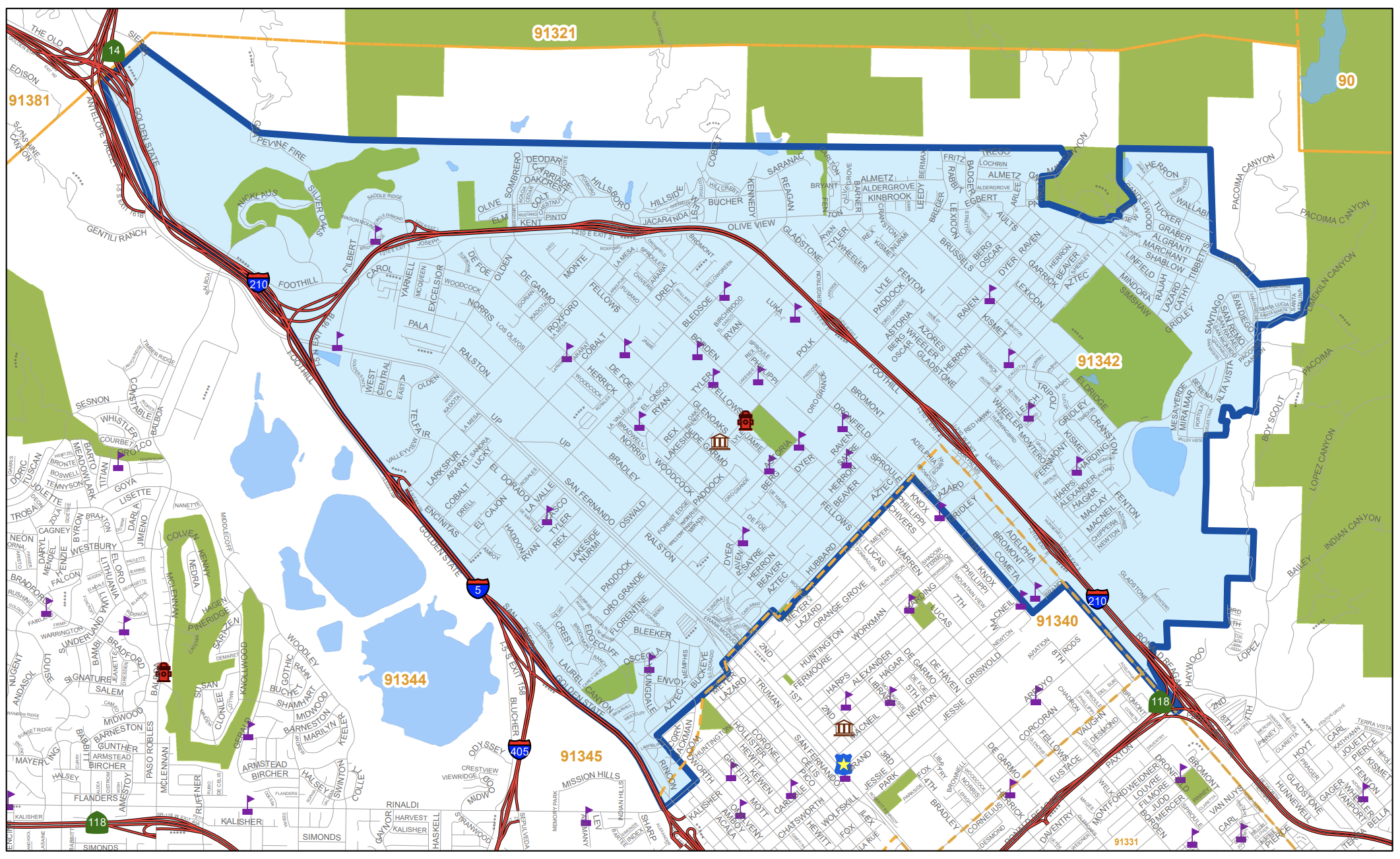
Area Boundaries and Map
View our neighborhood council boundaries for which we deal with.

EMPOWER LA

NEIGHBORHOOD COUNCIL CALENDAR & EVENTS
The public is invited to attend all meetings.
NEIGHBORHOOD COUNCIL FUNDING SYSTEM DASHBOARD

SUBSCRIBE TO NC MEETING NOTIFICATION